The rain had started turning into sleet by the time the black SUVs stopped beside the curb.
Water splashed over the teenagers’ sneakers as four men in dark tactical jackets jumped out almost before the vehicles fully stopped moving. One of them shoved through the crowd with his hand pressed to an earpiece while another scanned the sidewalk and nearby traffic with hard, practiced eyes.
Then the oldest agent reached Walter first.
“Master Sergeant Harris,” he said sharply. “Are you alright, sir?”
The entire street went silent.
One of the teenagers actually stepped backward.
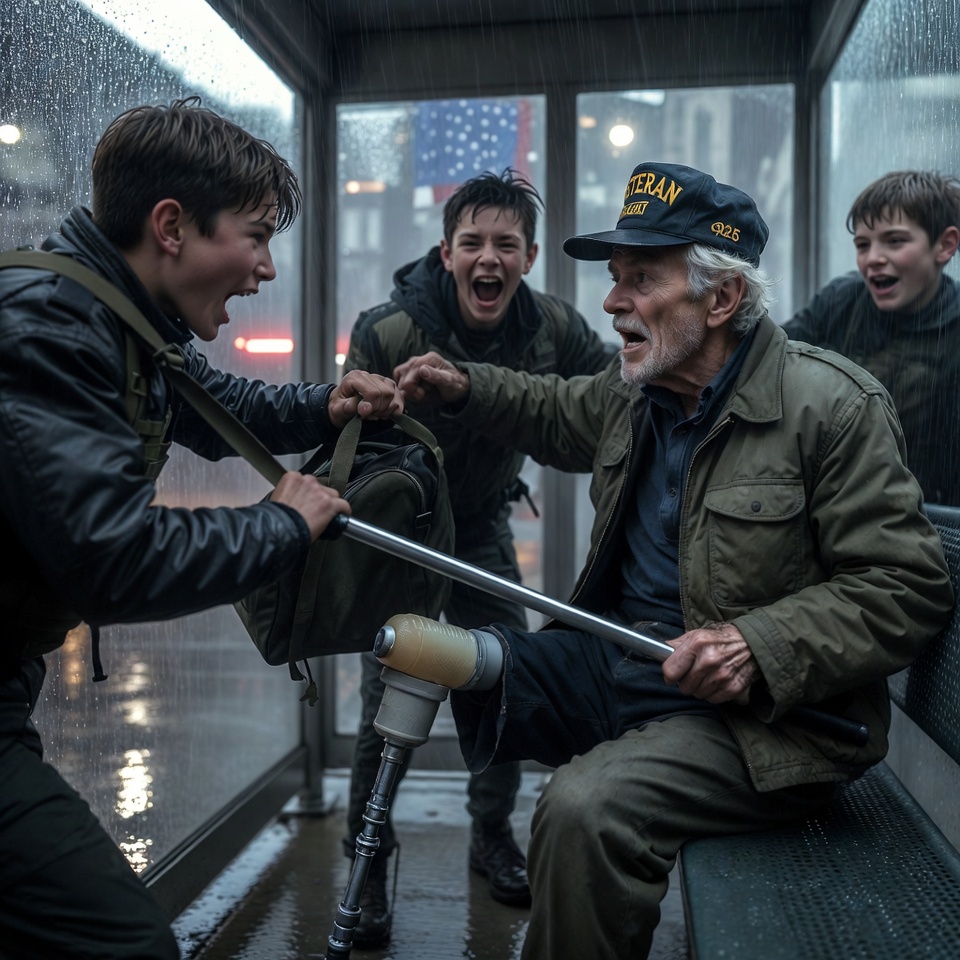
Walter didn’t answer immediately. His weathered hand stayed wrapped around the strap of the black duffel bag resting beside the bench. Rain dripped from the brim of his cap while he glanced once toward the boys who had been laughing at him less than a minute earlier.
The tallest one swallowed hard.
“What… what’s going on?” he muttered.
Nobody answered him.
The tactical agent crouched near the duffel bag carefully.
“Did anyone touch this besides you, sir?”
Walter nodded once toward the teenagers.
The boy nearest the bench immediately lifted both hands.
“I didn’t steal nothing, man.”
Another agent stepped between the boys and Walter instantly.
“Stay where you are.”
That changed the mood completely.
The arrogance vanished first. Then the laughter. Then whatever courage those boys thought they had when they mocked an old man sitting alone in the rain.
People nearby started pulling out phones.
One woman whispered, “Oh my God…”
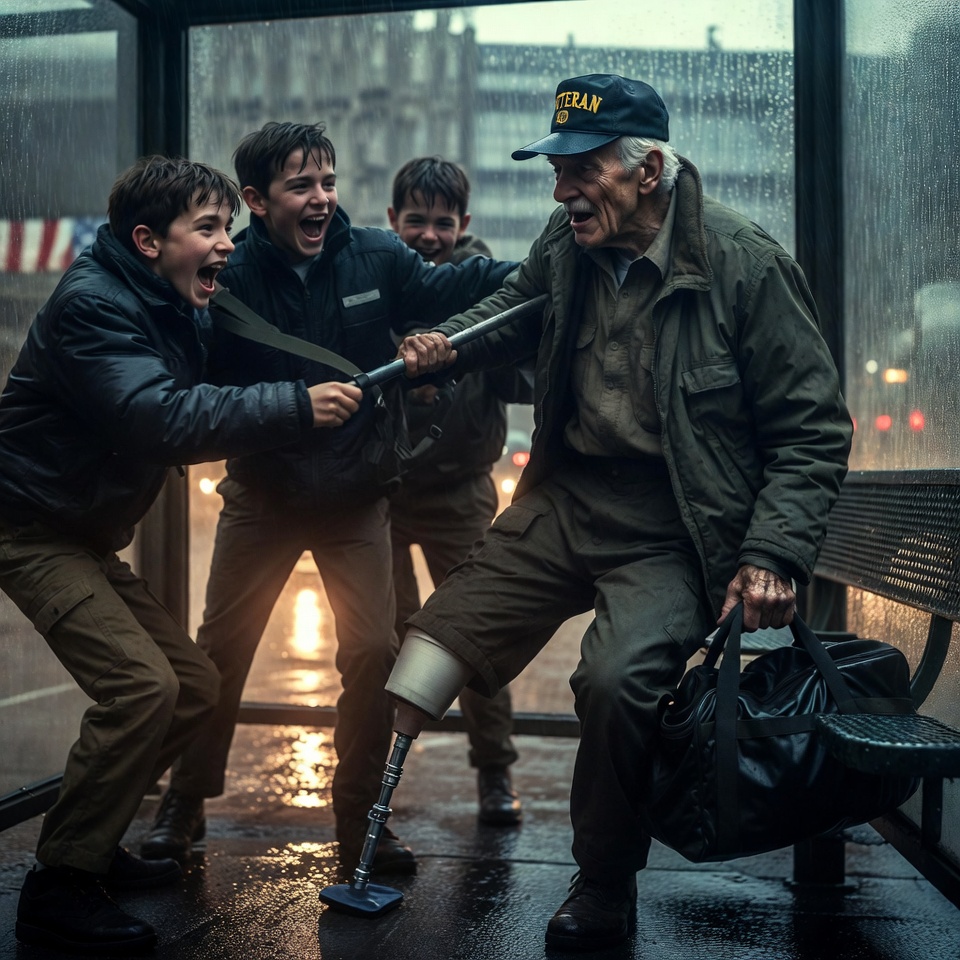
The tallest teenager looked at Walter again, finally seeing him clearly for the first time. Not as some lonely disabled man at a bus stop. Not as an easy target.
As someone dangerous.
As someone important.
As someone trained.
Walter slowly lowered himself back onto the bench with visible effort. His prosthetic clicked softly against the wet concrete.
The tactical agent beside him spoke quietly now.
“The FBI convoy got delayed in traffic. We’re sorry, sir.”
That sentence hit harder than shouting ever could.
The boys stared.
FBI.
One of them looked like he might throw up.
Years earlier, Walter Harris had worked alongside federal investigators after retiring from military service. Most people never knew that part of his history because Walter never talked about it. After losing his leg overseas, he spent nearly a decade assisting counterterrorism operations stateside, helping identify explosives and military-grade devices.
That black duffel bag sitting beside the bench wasn’t random.
It contained evidence from an ongoing federal investigation.
And the teenagers had nearly grabbed it.
The tallest boy suddenly pointed toward Walter.
“Why was he sitting out here alone then?”
The question came out desperate.
Like if he could make Walter seem smaller again, maybe the fear crawling into his chest would disappear.
Walter finally looked at him directly.
“Because I like the bus,” he said quietly.
No anger.
No speech.
That somehow made it worse.
The FBI agents escorted the boys toward the curb while local police cruisers arrived moments later, blue lights reflecting across puddles and storefront windows. The same pedestrians who ignored Walter twenty minutes earlier now stared openly at him.
One older man removed his baseball cap.
A young woman holding grocery bags whispered, “Thank you for your service.”
Walter looked uncomfortable hearing it.
That part surprised people too.
Because heroes in movies usually stand taller after moments like this. They enjoy the attention. They deliver speeches.
Walter just looked tired.
At 6:08 p.m., one of the agents handed him a fresh coffee from the convenience store across the street. Steam curled into the freezing air while police questioned the teenagers under the flashing lights.
The tallest boy kept glancing toward Walter over and over.
Finally, after nearly fifteen minutes, he walked slowly toward the bench again under an officer’s supervision.
Rainwater soaked through the kid’s hoodie. His face looked younger now somehow. Smaller.
“I didn’t know,” he muttered.
Walter stared quietly at the street.
“That’s the problem,” he answered.
The teenager swallowed hard.
“My dad was in the Marines,” he said softly. “I just… I don’t know why we did that.”
Walter looked at him then.
Really looked at him.
Fear. Shame. Confusion. The ugly crash after cruelty stops feeling funny.
Walter had seen those same expressions on frightened eighteen-year-old soldiers overseas decades earlier.
Young men pretending to be harder than they really were.
He took a slow sip of coffee before speaking.
“You think weakness looks obvious,” he said. “Most boys your age do.”
The teenager lowered his eyes.
Walter tapped the side of his prosthetic lightly.
“This isn’t what made me weak.”
The kid’s breathing hitched slightly.
Behind them, the FBI agents loaded the duffel bag into one of the SUVs while police continued writing reports beneath the flashing lights.
Chicago traffic crawled past slowly now, drivers staring through rain-covered windows.
Walter leaned back against the cold bench.
“You know what people see first?” he asked quietly. “The missing leg. The limp. The old clothes.”
The boy nodded once.
“They never ask what happened before.”
The teenager’s eyes turned red around the edges.
For several seconds, neither of them spoke.
Rain ticked softly against the metal roof overhead.
Then Walter reached into his jacket pocket again and pulled out an old photograph folded at the corners. Three young soldiers stood beside him in desert uniforms, all smiling into the sun with dust covering their boots.
Only Walter survived that mission.
The teenager stared at the photo carefully.
“That was before?” he asked.
Walter nodded once.
“My friends were nineteen. Twenty. Twenty-two.”
The kid’s face twisted.
One of the agents called from the SUV.
“We’re ready, sir.”
Walter folded the photo carefully and slipped it back into his pocket.
Before standing, he looked at the teenager one final time.
“Being loud doesn’t make you strong,” he said quietly. “Protecting people does.”
The boy couldn’t answer.
Walter rose slowly with the help of his cane while the prosthetic locked into place with a soft mechanical click. One FBI agent moved instinctively beside him, ready to help, but Walter waved him off gently.
He could still walk on his own.
The crowd parted as he crossed the sidewalk toward the SUVs. Nobody laughed anymore. Nobody looked away either.
The tallest teenager suddenly called after him.
“Sir.”
Walter paused.
“I’m sorry.”
The old veteran stood still for a moment while freezing rain blew across the street. Then he nodded once without turning around.
Not forgiveness exactly.
But not hatred either.
The SUVs disappeared into traffic seconds later, taillights glowing red against the storm-dark street while the police remained behind with the teenagers.
The bus stop looked strangely empty afterward.
Just a bent paper coffee cup near the bench.
A fallen cane mark in the puddles.
And silence.
Hours later, the tallest boy returned alone to that same corner after the police released them to their parents. The rain had finally stopped by then. Cold wind swept trash across the sidewalk while traffic lights blinked yellow after midnight.
He stood staring at the empty bench for a long time.
Then he bent down and picked up something half-hidden beneath the seat.
A small military challenge coin.
Heavy. Worn smooth at the edges.
One side carried an American flag.
The other read:
“No one fights alone.”
The boy closed his hand around it tightly while the empty street hummed quietly around him.
And for the first time that night, he understood why Walter Harris never needed to raise his voice.