The older man’s badge was small, gold, and worn at the edges.
He didn’t flash it dramatically. He didn’t raise his voice. He simply held it open beside his chest while the train doors tried to close behind the officers.
The woman stared at it first like she didn’t understand what metal could do to a room.
Then she understood.
Her hand slid down from the pole.
The transit officer holding my envelope looked at the older man.
“Detective?”
“Retired,” the man said. “But I still know assault when I see it.”
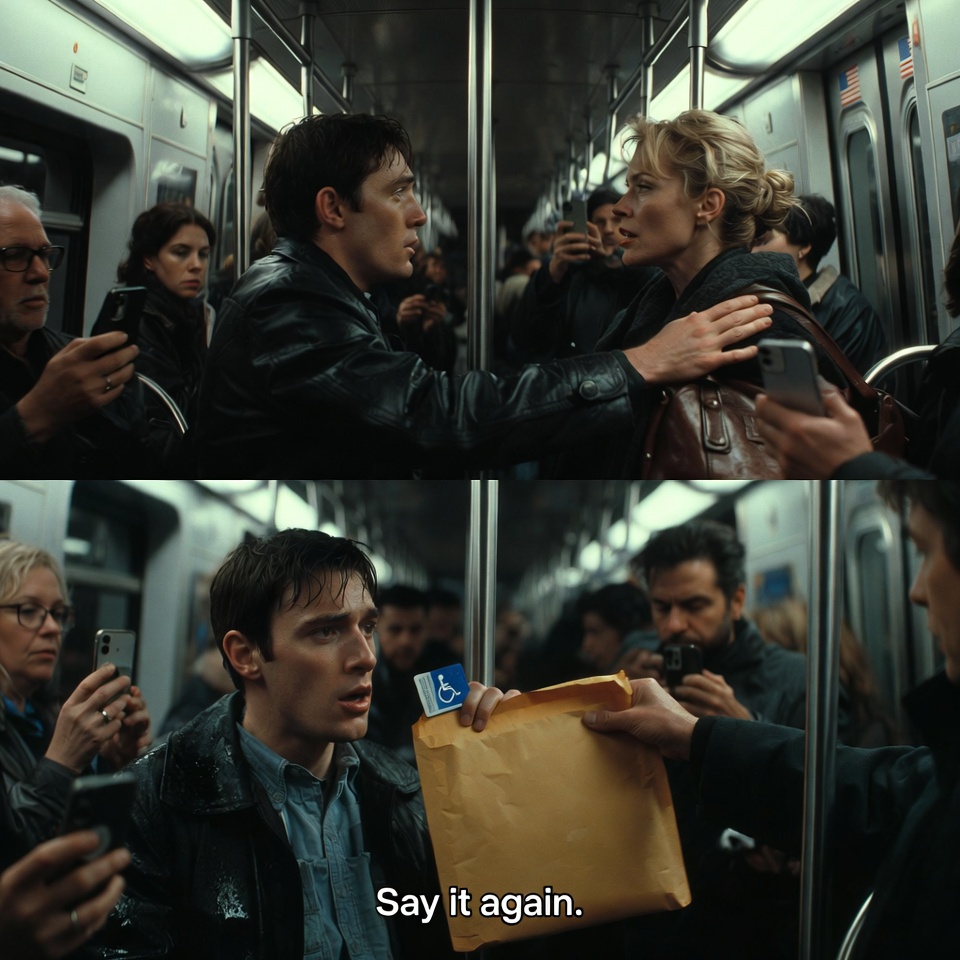
The woman’s face pinched.
“I didn’t assault anybody. I bumped him. This is ridiculous.”
The teenage boy across from us whispered, “She hit him twice.”
His friend nodded fast.
I kept my hand on the envelope because it was the only thing that stopped my fingers from shaking.
The officer asked my name.
“Caleb Martin.”
The woman snapped her eyes toward me like hearing my name made me more real and less convenient.
The officer turned one page in the envelope. His expression changed when he saw the surgery notes.
“Mr. Martin, are you okay standing long enough to step off with us?”
“No,” I said.
Just one word.
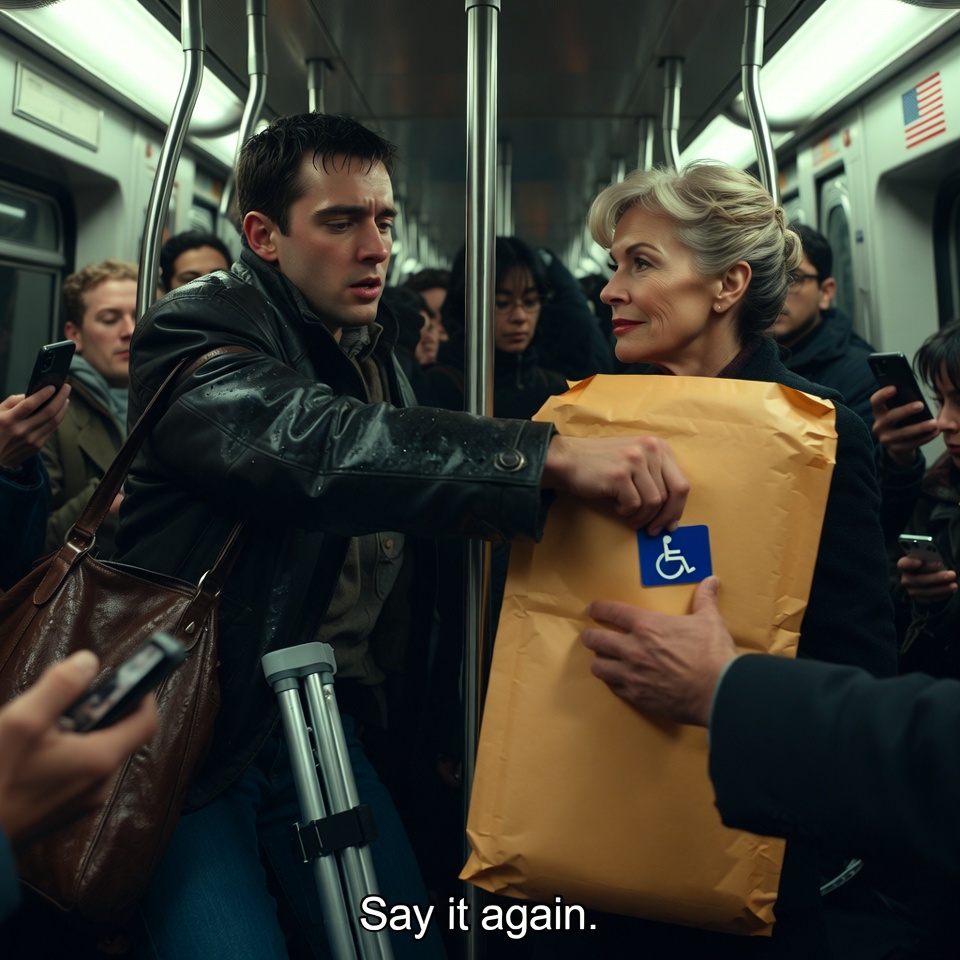
The whole car heard it.
The officer nodded once.
“Then we’ll handle this right here.”
Two months earlier, I would’ve stood. That was the worst part. I would’ve smiled, apologized for existing, and limped home in pain because my mother raised me to be polite even when strangers sharpened their teeth on me.
Before the accident, I worked twelve-hour shifts repairing elevators in office towers. I carried tools up service stairs. I ate gas station sandwiches at 10:30 p.m. and sent $600 every month to my younger sister while she finished nursing school.
Then a delivery van ran a red light on Wabash.
My left knee folded wrong. My shoulder hit pavement. My phone cracked under a tire.
At 9:16 a.m., I was a man walking to work.
At 9:17 a.m., I was a case number, an insurance claim, and a body strangers felt allowed to judge because I still looked young.
That morning at Northwestern Memorial, the surgeon told me the nerve damage might heal slowly.
Might.
He said the word gently, like softening it would change what it meant.
The social worker handed me the blue disability card and a temporary transit pass. She told me not to be embarrassed.
“People can’t see every injury,” she said.
I had laughed once.
By 5:42 p.m., I understood why she said it.
The woman in the gray coat crossed her arms.
“I pay taxes,” she said, quieter now, but still polished. “I’m allowed to ask for a seat.”
“You didn’t ask,” the officer said.
She blinked.
“I beg your pardon?”
“You ordered. Then you struck him with your bag.”
Her neck flushed above the collar of her coat.
The retired detective took a step closer, not blocking her, just making sure she knew there was nowhere left to perform.
“I watched you reposition the bag before the second hit,” he said. “That wasn’t crowding. That was choice.”
A man in a Cubs cap raised his hand slightly.
“I saw it too.”
Then a woman with a stroller spoke.
“She made fun of him. Said he was deaf.”
The gray-coat woman turned toward them.
“Oh, please. Everyone is so sensitive now.”
That sentence did more damage to her than any shouting could have.
The officer’s face went flat.
“Ma’am, do you have identification?”
“For what?”
“For the report.”
Her bag suddenly looked heavier.
She opened it with sharp movements, pulling out a wallet, a compact mirror, a receipt from a store where one scarf cost more than my electric bill.
While she searched, the train sat still.
People outside on the platform looked in, annoyed at first, then curious.
I looked down at my knee brace.
The black strap had slipped. A red line cut across my skin where it had rubbed raw.
The officer noticed.
“Do you need medical assistance?”
“No. I need to get home.”
The retired detective looked at me then.
Not with pity.
That mattered.
Pity feels like someone putting you in a smaller room. This man looked at me like I was still standing, even while seated.
“What happened to your leg?” he asked.
“Work accident,” I said. “Van hit me.”
The woman made a small sound.
Not sympathy.
Impatience.
The officer wrote her name down.
Patricia Wells.
She lived in River North. She had a corporate ID clipped inside her wallet and a diamond bracelet that clicked against her watch.
The officer asked if she wanted to make a statement.
She lifted her chin.
“Yes. I asked a young man to show basic manners. He escalated by making a scene.”
Nobody spoke for two seconds.
Then the teenager with the phone said, “I recorded the whole thing.”
Patricia turned slowly.
“You recorded me?”
He swallowed, but kept the phone up.
“Yeah.”
The retired detective said, “Good.”
That one word changed the air.
Patricia’s eyes moved from the phone to the officer to my hospital envelope.
For the first time, she wasn’t looking for an audience.
She was looking for an exit.
At the next stop, the officers asked her to step off.
She refused at first.
“I have a meeting.”
The officer said, “You have a report.”
Her mouth opened, then closed.
She stepped onto the platform with the stiff posture of someone trying to make consequences look voluntary.
Before she left, she looked back at me.
For one strange second, I thought she might apologize.
Instead, she said, “You should display that card where people can see it.”
The retired detective answered before I could.
“Or you could stop hitting strangers.”
The doors closed on her face.
Inside the car, nobody clapped. Real life isn’t always that neat.
But people shifted.
A woman across from me moved her grocery bag so my cane had more space.
The teenager lowered his phone.
“Sorry, man,” he said.
I nodded.
The train started moving again.
At Washington, the retired detective sat beside me.
“Name’s Harold Bennett,” he said. “Thirty-two years Chicago PD.”
“Caleb.”
“I heard.”
He looked at the envelope.
“You got someone meeting you?”
“My sister. She gets off shift at 7.”
“Hospital?”
“Yeah.”
He nodded like that explained a whole family.
For three stops, we didn’t talk.
The city blurred black and gold outside the glass. My knee pulsed with each vibration of the tracks. My phone buzzed once with a payment reminder from the hospital portal.
$18,640.
Due in thirty days.
I turned the screen down.
Harold saw it anyway.
He didn’t comment. Another thing I appreciated.
When my stop came, I unfolded the cane under the seat. The motion was awkward. I hated that part most: the extra seconds, the attention, the way my body had become a schedule everyone else had to wait around.
Harold stood first.
Not to help without asking.
Just to make room.
“You want backup to the elevator?”
I almost said no.
Pride is expensive when your leg is failing.
“Yeah,” I said.
He walked beside me through the station, slow enough that I didn’t have to ask him to slow down.
Near the elevator, my phone rang.
My sister’s name lit the screen.
“Abby.”
“Where are you?” she asked, breathless. “I just got out.”
“Monroe.”
“You sound weird.”
“I’m fine.”
“No, you’re doing that thing.”
“What thing?”
“The ‘I’m fine’ thing that means someone needs to be buried.”
Harold coughed once, hiding a laugh.
I told her the short version.
There was silence.
Then Abby said, “Did you get her name?”
Harold leaned closer.
“Patricia Wells.”
I repeated it.
My sister went quiet again, but this time it was different.
“Caleb,” she said slowly. “Does she work for Latham & Rowe?”
I looked at Harold.
“She had a corporate badge,” I said. “Why?”
Abby exhaled hard.
“Because Latham & Rowe handles the insurance defense for the delivery company fighting your claim.”
The elevator doors opened.
For the first time all day, my pain moved somewhere else.
Behind my ribs.
“What?”
“She might not be random,” Abby said. “I saw that name in your case file last week. Patricia Wells. Senior claims consultant.”
Harold’s head turned toward me.
The elevator beeped.
Nobody stepped inside.
My sister kept talking.
“She was copied on the email saying they wanted surveillance to prove you were exaggerating your injury.”
The station noise stretched thin.
My hand tightened around the cane.
Harold’s voice dropped.
“Caleb. Did she see your envelope before she started?”
I thought back.
The bag hitting my knee.
Her eyes dropping to the manila folder.
The way she looked at my leg before she spoke.
Not righteous.
Recognizing.
“Yes,” I said.
Harold’s jaw worked once.
“Then you need more than a transit report.”
By 8:03 p.m., Abby had made coffee in my apartment so strong it could strip paint. She sat at my kitchen table in blue scrubs, hair still pinned from her shift, laptop open, eyes narrowed.
Harold stood near the counter, calling a former colleague.
I sat with my leg elevated on a chair and watched my little sister become terrifying.
“She works for them,” Abby said. “Not directly your adjuster, but adjacent. She reviewed your file.”
“Maybe it was coincidence.”
Abby looked at me over the laptop.
“Caleb.”
I shut up.
She clicked through documents.
“There. Her name. March 14. March 22. April 3. She requested updated mobility observations.”
Harold ended his call.
“My friend says the platform cameras will be preserved if you file tonight.”
Abby turned the laptop toward me.
On the screen was an email chain.
Patricia Wells had written one line under my medical summary:
Subject appears ambulatory. Recommend public activity review.
Subject.
Not man.
Not injured worker.
Subject.
At 8:41 p.m., Abby uploaded the subway video to our attorney’s secure portal.
At 9:12 p.m., my attorney called.
Her name was Denise Carter, and she had the calm voice of someone who made expensive people regret underestimating paperwork.
“Caleb,” she said, “do not speak to anyone from the insurance company. Not by phone, not by email, not if they knock on your door.”
“Okay.”
“Second, that woman made contact with you in public after reviewing your confidential injury file. We’re going to ask why.”
Abby mouthed, Yes.
Denise continued.
“Third, the video helps your case. Not because she was rude. Because you remained seated, showed documentation, and multiple witnesses confirmed mobility impairment.”
I looked at the cane leaning against the table.
“So being humiliated is useful now?”
Denise paused.
“No. But evidence is.”
The next morning, Patricia Wells became very interested in apologizing.
At 10:06 a.m., she called from a blocked number.
I didn’t answer.
At 10:11, she emailed.
Mr. Martin, yesterday’s misunderstanding was unfortunate. I hope we can resolve this privately.
Denise replied for me.
Please direct all communication to counsel.
At 10:29, Patricia sent another email.
There is no need to involve Latham & Rowe.
Denise forwarded that one to the judge assigned to the insurance dispute.
By noon, the transit authority confirmed the footage.
By 2:35 p.m., the teenage boy’s mother called my attorney. She had seen the video on her son’s phone and wanted to provide a statement.
By 4:00 p.m., Harold Bennett signed his affidavit.
Patricia’s company tried to distance itself from her by sunset.
But distance is hard when your name sits inside the file.
Three weeks later, we sat in a conference room with gray carpet, a long table, and water bottles nobody touched.
Patricia was there.
So was her supervisor.
So were two attorneys whose smiles looked stapled on.
My knee brace was visible because Denise told me not to hide it.
The defense attorney began carefully.
“We acknowledge Ms. Wells’s conduct on the train was inappropriate.”
Denise folded her hands.
“Inappropriate is chewing gum in court.”
The room went still.
“She physically struck an injured claimant whose file she had accessed,” Denise said. “Then attempted to pressure him into silence.”
Patricia’s supervisor shifted.
“We dispute the characterization of pressure.”
Denise slid the printed email across the table.
Resolve this privately.
Nobody touched it.
Then Harold’s affidavit came out.
Then the video.
Then the transit report.
Patricia stared at the table through the whole thing.
The defense attorney asked for a break.
Denise said no.
By the end of that meeting, the delivery company stopped fighting my surgery coverage. The settlement changed from survival money to actual recovery money.
Not millions.
Not some movie miracle.
But enough to cover the $18,640 bill, the second procedure, six months of rent, physical therapy, and the wages I had lost while they tried to prove I was lying.
Patricia was terminated two days later.
I didn’t celebrate.
That surprised Abby.
“You’re allowed to be happy,” she said.
“I’m relieved.”
“That counts.”
Maybe it did.
A month after the subway incident, I took the train again at 5:42 p.m.
Same line. Same hour. Same tired city pressed shoulder to shoulder underground.
A woman with silver hair boarded at Lake.
She looked exhausted. Actually exhausted. One hand on her lower back, the other gripping a pharmacy bag.
I stood before she reached me.
Slowly.
Carefully.
Her eyes dropped to my brace.
“Oh, honey, no—”
“It’s okay,” I said.
She hesitated.
Then she sat.
“Thank you.”
I held the pole and felt the train move beneath my feet.
My knee hurt.
But not every sacrifice is surrender.
Sometimes you give something freely because nobody demanded it from you.
At Monroe, I saw my reflection in the dark window: cane in one hand, scar under denim, shoulders straighter than they had been before.
My phone buzzed.
A message from Abby.
PT tomorrow. Don’t skip. I know where you live.
I smiled.
The train doors opened.
People moved around me, carrying bags, umbrellas, tired faces, private battles no one could see.
This time, nobody had to prove they deserved kindness.